
A recent Visual Capitalist (Charted: China’s Energy Needs Keep on Rising) breakdown highlights a reality many prefer to ignore: global energy consumption is accelerating, not slowing down. China alone already consumes more energy than the U.S. and EU combined (by 2030, China’s total energy consumption is projected to grow by another ~20–25%), and projections show its demand continuing to rise sharply through 2030 and beyond. India is following a similar trajectory, while developed economies are flattening—but not meaningfully reducing—overall demand.
What’s striking is the contrast between today’s energy leaders and tomorrow’s projections:
- China and India are driving most of the future growth in energy consumption.
- The U.S. and Europe remain heavily dependent on stable global energy supply chains.
- Many nations still rely significantly on oil and gas imports, making them vulnerable to geopolitical shocks, supply disruptions, and price volatility.
At the same time, countries are making very different strategic bets:
- Some are investing aggressively in renewable energy infrastructure (solar, wind, storage).
- Others are betting disproportionately on AI and advanced automation, assuming energy availability will somehow “figure itself out.”
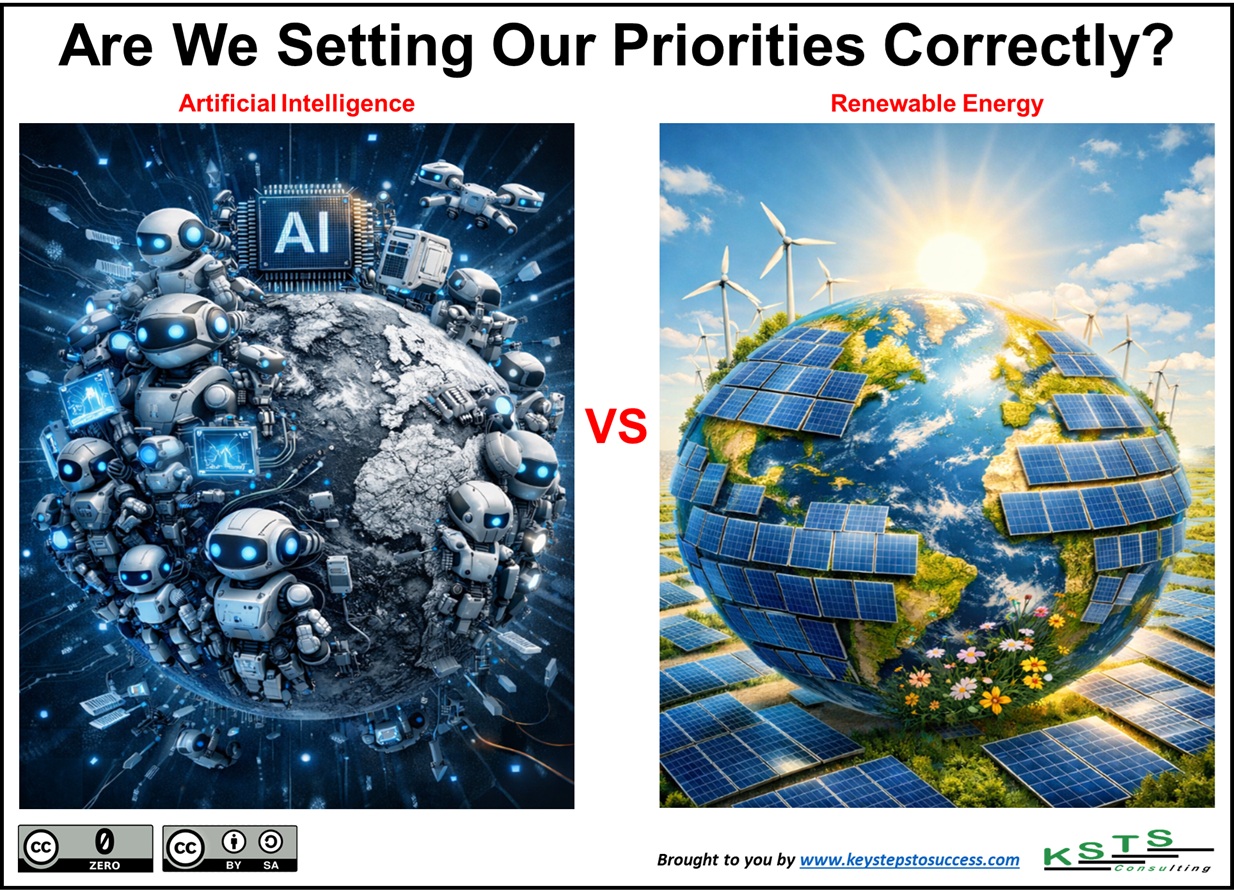
And here’s the irony we’re not talking about enough: AI requires astronomical amounts of energy. Data centers, model training, inference at scale—all of it is power-hungry. Letting AI lead the strategy before securing cheap, abundant, resilient energy is like sending armored vehicles into battle at full speed without fuel trucks, repair units, or supply lines. It looks impressive—until everything stalls.
This also raises uncomfortable questions about the job market and ROI:
- Companies and governments are pouring hundreds of millions into AI.
- Many organizations still struggle to show clear, sustainable returns.
- Meanwhile, job displacement anxiety is rising faster than reskilling, energy transition, or social adaptation.
So the real question is: are we focused on the right thing?
Instead of prioritizing job preservation and meaningful employment, large-scale renewable energy creation, planetary sustainability and a balanced coexistence between technology and humanity, some countries appear to be accelerating into a kind of “stone age of artificial everything”—where robotic dominance grows faster than the energy systems that support it, and where human value is quietly trivialized.
Technology should serve civilization — not outrun the very systems that make civilization possible. Energy is not a footnote to the AI story. It is the story.