
In recent years, many organizations have embraced product thinking, often declaring that they are transitioning from a project-centric to a product-centric operating model. Project managers have become product managers, project teams have been reorganized into product teams, and traditional project plans have given way to product roadmaps and backlogs. On the surface, the transformation appears convincing. However, beneath the new terminology and organizational charts, many companies continue to manage their work through the same funding mechanisms, governance structures, and decision-making practices that defined their project-oriented past.
This raises an uncomfortable question: Has the organization genuinely changed how it creates value, or has it simply changed what it calls the work?
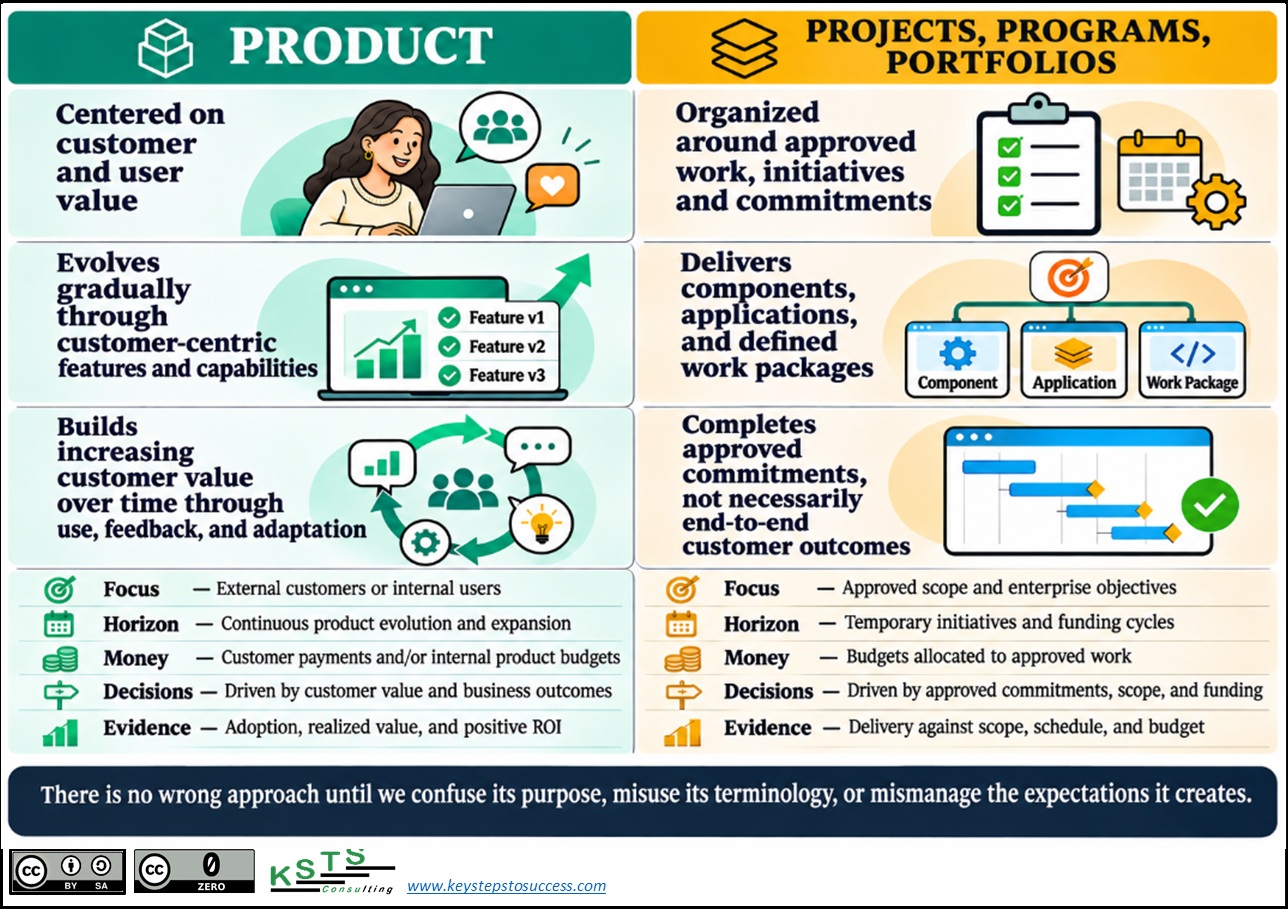
The distinction matters because products, projects, programs, and portfolios are not interchangeable concepts. They serve different purposes, operate across different horizons, and create different expectations about what success should look like. None is inherently superior to the others. Problems begin when organizations confuse their purposes, apply the wrong management practices, or expect outcomes that their operating models are not designed to produce.
1. When Everything Is Delivered, but the Customer Is Still Waiting
Consider a subscription software company that wants to improve how quickly new customers can begin using its product after signing a contract. Leadership recognizes that onboarding is taking too long and approves an initiative to streamline the experience. A project is established to develop a new setup wizard. A program coordinates the work of engineering, security, implementation, and customer support. The portfolio management function oversees investment, spending, and progress against approved objectives.
Eventually, the setup wizard is delivered on schedule and within budget. The project manager reports successful completion. The program manager confirms that participating teams fulfilled their commitments. The portfolio review shows that the investment remained within its financial boundaries. By conventional delivery measures, the organization has performed well.
Unfortunately, customers are still waiting weeks before they can begin using the software. The setup wizard works, but access permissions require additional approvals, data imports involve separate teams, and several critical onboarding activities remain fragmented across organizational boundaries. Every delivery report may be accurate, yet the customer experience remains largely unchanged.
The problem is not necessarily that the project was poorly managed or that the program failed to coordinate its participants. The deeper issue is that the organization defined and measured success around the completion of approved work rather than the customer’s ability to accomplish something valuable. The organization successfully delivered what it had committed to build, but it had not necessarily improved what the customer needed to accomplish. That distinction lies at the heart of the difference between managing products and managing projects, programs, and portfolios.
2. Product Thinking Begins With the Customer, Not the Work
A product exists to serve a recurring need, solve a problem, or enable an outcome for its users. Those users may be external customers purchasing a commercial offering or internal employees relying on an enterprise platform, application, or service.
What makes something a product is not simply that it has a name, a roadmap, a backlog, or a dedicated manager. It is the presence of an identifiable user population, an ongoing value proposition, and the ability to evolve the offering as needs and circumstances change.
A product does not ordinarily reach a permanent state of completion when its initial capabilities are delivered. It evolves incrementally through new features, improved functionality, operational refinements, and sometimes the removal of capabilities that no longer contribute sufficient value. Importantly, this evolution should not be confused with continuously adding features. Product development is not an endless exercise in expanding functionality. It is an ongoing effort to improve the relationship between what users need, what the product enables, and what the business gains from providing it.
Returning to our software company, a product-centric approach would begin with a different question. Instead of asking whether the new setup wizard has been delivered, the organization would ask how quickly customers can successfully begin using the product and what prevents them from doing so. The wizard might be one part of the solution. Automated permissions, streamlined data migration, better documentation, or improved integration with existing customer systems might prove equally important.
As customer evidence accumulates, priorities would evolve. Some previously planned features could become less important, while newly discovered obstacles might deserve immediate attention. This is where genuine product thinking differs from simply managing an application backlog. The product boundary should follow the value experienced by its users, not merely the technical components or departmental boundaries established by the organization.
3. Projects, Programs, and Portfolios Serve a Different Purpose
Projects, programs, and portfolios provide essential mechanisms for organizing investments, coordinating work, and exercising financial and operational control. A project typically represents a temporary undertaking established to deliver a defined result. It has an intended outcome, an agreed scope, a funding arrangement, and a recognizable beginning and end.
A program coordinates related initiatives and dependencies to achieve benefits that individual projects might not deliver independently. A portfolio provides a broader investment perspective, helping leadership determine where resources should be allocated, which initiatives should continue, and which should be changed or discontinued.
These disciplines can also support customer value. Programs may be explicitly organized around business benefits, and portfolios may prioritize investments based on strategic outcomes. Nevertheless, their operational mandates are frequently expressed through approved objectives, scope, commitments, budgets, and funding cycles. This creates an important distinction between what is being managed and what is being experienced.
A project may deliver a component. Another project may modernize an application. A program may coordinate their integration, while a portfolio may evaluate their collective expenditure and strategic importance. Yet none of these arrangements automatically guarantees that someone has responsibility and sufficient authority to improve the entire customer experience across all those boundaries.
In the onboarding example, individual projects might successfully deliver the setup wizard, permissions service, and data migration functionality. Their collective success would still depend on whether customers could move through the complete onboarding process without unnecessary friction. This is not an argument against project, program, or portfolio management. It is an argument against confusing the management of approved work with the ongoing management of customer value.
4. Follow the Money: Two Different Directions of Value and Investment
Perhaps the most revealing way to understand the distinction is to examine how money moves through an organization. In a commercial product business, value travels toward the customer through the product, while payments travel back toward the business. Customer adoption, retention, expansion, and willingness to continue paying provide evidence about whether that relationship remains economically viable. This is a continuous exchange. The organization invests in maintaining and improving the product because doing so is expected to generate or sustain value over time.
Internal products operate under a somewhat different financial arrangement. An internal technology platform, for example, may not collect payments from its employees or internal departments. Instead, its development and operation are financed through an internal budget. The platform’s value may appear through greater productivity, reduced operating costs, improved reliability, faster delivery, or better organizational capabilities.
The absence of an external customer payment does not make the internal offering any less of a product. Nor does the use of an internal budget imply that its spending is undesirable. The important consideration is whether the investment continues to produce sufficient value for its users and the enterprise.
Project, program, and portfolio funding generally follows a different direction.
Financial authority flows from enterprise leadership toward approved initiatives, while information about spending, delivery, risks, and expected benefits flows back toward those responsible for investment oversight.
Both arrangements consume real money. Both require economic discipline. Both can contribute to business outcomes. However, customer payments, internal product budgets, and funding allocated to temporary initiatives are not the same economic relationships.
A customer payment represents cash received in exchange for an offering or service. An internal product budget authorizes the organization to invest in capabilities intended to produce recurring value. A project budget authorizes spending against a defined undertaking.
There are exceptions and overlaps. Client-funded projects may directly generate revenue, and product development may involve substantial project-based investments. The distinction is therefore not simply who pays, but what the money is expected to accomplish, how success is evaluated, and how investment decisions can respond to new evidence.
Understanding these differences becomes especially important when organizations attempt to implement product operating models without changing their underlying financial governance.
5. When Funding Boundaries Become Product Boundaries
Organizational design often follows the money more closely than it follows the customer. Imagine that our software company approves separate budgets for its setup wizard, identity management application, and data migration capabilities. Each investment receives a sponsor, a team, a delivery plan, and perhaps even someone carrying the title of product manager.
Over time, each funded area develops its own roadmap, backlog, objectives, and reporting structure.
From an investment governance perspective, these arrangements appear reasonable. They make it easier to identify spending, allocate responsibility, and monitor progress. From the customer’s perspective, however, these distinctions are largely irrelevant. Customers do not care which department manages identity permissions or which funding initiative owns data migration. They simply want to begin using the software they purchased. The real organizational difficulty emerges when customer feedback reveals that the most important improvement falls outside an existing team’s approved scope or funding boundary.
Suppose the company discovers that customers navigate the new setup wizard with ease but continue to wait ten days for account permissions. The product manager responsible for the wizard recognizes the problem but cannot redirect the identity management team’s priorities. That team operates under a different budget, roadmap, and set of commitments. Resolving the issue may require escalation, additional approvals, a revised business case, or the next annual planning cycle. The company has collected meaningful customer feedback but lacks the organizational flexibility to act on it.
This demonstrates why product management cannot be reduced to maintaining a backlog or supervising the development of an application. Effective product ownership requires decision-making authority proportionate to the outcomes for which the individual or team is held accountable.
Component and application stewardship remain legitimate and often technically demanding responsibilities. The dysfunction appears when organizations assign accountability for broad customer or business outcomes to people whose authority extends only to a narrow technical or financial boundary. The title may say product manager, but the operating model still treats the person as a manager of predetermined work.
6. The Difference Between Delivering Commitments and Creating Value
The distinction also becomes visible in how organizations measure performance. Projects commonly report progress through scope completion, schedule adherence, budget performance, and milestone achievement. Programs may supplement these measures with dependency management and benefits realization. Portfolios may examine investment allocation, strategic alignment, risk exposure, and expected returns.
These are legitimate management concerns. Organizations must understand how much money they are spending, what obligations they have accepted, and whether the work they authorized is progressing responsibly. The problem arises when delivery measures become substitutes for evidence of actual value.
A product-centric organization should also examine adoption, user behavior, retention, satisfaction, operating efficiency, realized benefits, and economic return. Not every product requires the same metrics. A commercial subscription platform may emphasize retention and revenue expansion, while an internal platform may emphasize reduced cycle times, lower operational costs, or improved service reliability.
In both cases, the fundamental question remains whether users are receiving meaningful value and whether the organization can justify its continuing investment.
A product can be delivered on time and still fail commercially. Conversely, a product team may change its original plans, defer features, or abandon a proposed solution after discovering a more valuable opportunity. From a commitment-driven perspective, such changes can appear to represent instability or poor planning. From an adaptive product perspective, they may demonstrate precisely the learning and judgment that responsible investment management requires.
The difference is not that one approach values discipline while the other rejects it. Both require discipline, but they apply it to different objects of management.
Project discipline helps organizations honor and control commitments. Product discipline helps organizations continually test whether those commitments are still the right ones.
7. The Operating Model Must Allow Money and Decisions to Move
An organization does not become product-centric merely by establishing persistent teams or assigning product managers. It must also reconsider how funding, decision rights, accountability, and evidence interact.
Certain undertakings are naturally suited to project-based funding.A regulatory migration, office relocation, major infrastructure replacement, or one-time integration may have a clearly bounded purpose and a recognizable completion point. Other areas benefit from stable product investment because they serve ongoing user needs and must evolve continuously. A customer-facing software platform, an internal employee service, or an enterprise data capability may require persistent ownership, recurring discovery, and the flexibility to improve incrementally.
Where uncertainty is especially high, staged investment can be valuable. Rather than committing the entire budget to a predetermined solution, the organization can finance a smaller experiment, evaluate the evidence, and determine whether further investment is justified.
These approaches need not compete. A mature enterprise can use all of them, provided it understands their purposes and aligns management expectations accordingly.
The challenge is ensuring that the governance system does not unintentionally prevent valuable change.
Returning once more to the onboarding example, imagine that a product team identifies an opportunity to reduce the time to first successful use by improving permission provisioning rather than adding more features to the setup wizard.
The team tests the hypothesis with a small customer segment. Results demonstrate that the improvement materially reduces onboarding delays. The program addresses dependencies between the participating groups, while portfolio leadership reviews the evidence and reallocates investment accordingly.
In this arrangement, product management provides the ongoing understanding of customer needs and value. Program management facilitates coordinated change across organizational boundaries. Portfolio management enables investment decisions that reflect emerging evidence. Project management can still support bounded work within the broader effort. The disciplines complement one another rather than compete for organizational supremacy. What makes this arrangement effective is not its terminology. It is the ability to connect learning with authority and investment.
8. The Real Organizational Design Question
Organizations frequently debate whether they should manage products or projects, whether product managers should replace project managers, and whether traditional PMOs should evolve into product-oriented investment functions.
These debates can become surprisingly unproductive when they revolve around titles, frameworks, or ideological preferences rather than the actual nature of the work.
A more useful conversation begins by examining how decisions are made.
Who understands the complete customer experience? Who is accountable for the value an offering produces throughout its lifecycle? Who can change priorities when evidence contradicts the original plan? Who controls the allocation of people and money? Who decides whether an initiative should continue, change direction, or stop?
Perhaps most importantly, are the people responsible for outcomes empowered to influence the conditions necessary to achieve them? These questions expose the difference between organizational structures that merely distribute work and operating models that enable meaningful adaptation. The goal should not be to eliminate governance or abandon commitments. Rather, it should be to establish governance that distinguishes necessary commitments from assumptions that ought to change when better information becomes available.
Conclusion: The Wrong Approach Is Confusing the Purpose
Product management and project, program, and portfolio management are not opposing philosophies that require organizations to choose sides. They represent different ways of organizing responsibility, coordinating effort, allocating resources, and evaluating success.
Products are fundamentally concerned with sustaining and improving value for customers and users over time. Projects provide a disciplined means of accomplishing bounded undertakings. Programs coordinate related efforts and benefits, while portfolios guide broader investment choices. Each can be valuable when applied to the right problem, supported by appropriate decision rights, and evaluated using measures consistent with its purpose.
The real danger emerges when organizations borrow the language of product management while retaining governance mechanisms that restrict teams to predetermined components, applications, and commitments. It also emerges when companies expect project delivery measures to prove customer success, or demand long-term product outcomes from individuals whose authority ends with a short-term funding cycle.
Ultimately, the quality of an operating model is revealed not by its titles, organizational charts, or methodology, but by its ability to redirect resources when reality challenges the original plan. The next time a portfolio review celebrates successful delivery, there is one question worth asking:
When customers show us that the biggest obstacle lies outside the work we approved, who has the authority to move the money, redirect the people, and address the actual problem?
If the organization cannot answer that question, its challenge is probably not a shortage of product managers, project managers, frameworks, or processes. It is a disconnect between the value it claims to pursue and the decisions its operating model permits. And that brings us to the principle underlying the entire discussion: There is no wrong approach until we confuse its purpose, misuse its terminology, or mismanage the expectations it creates.