
There is a striking irony in how modern software development evolved over the last two decades. An industry that once promised creativity, innovation, engineering craftsmanship, and human collaboration has, in many organizations, quietly drifted toward the same industrial management patterns that dominated textile factories more than a century ago.
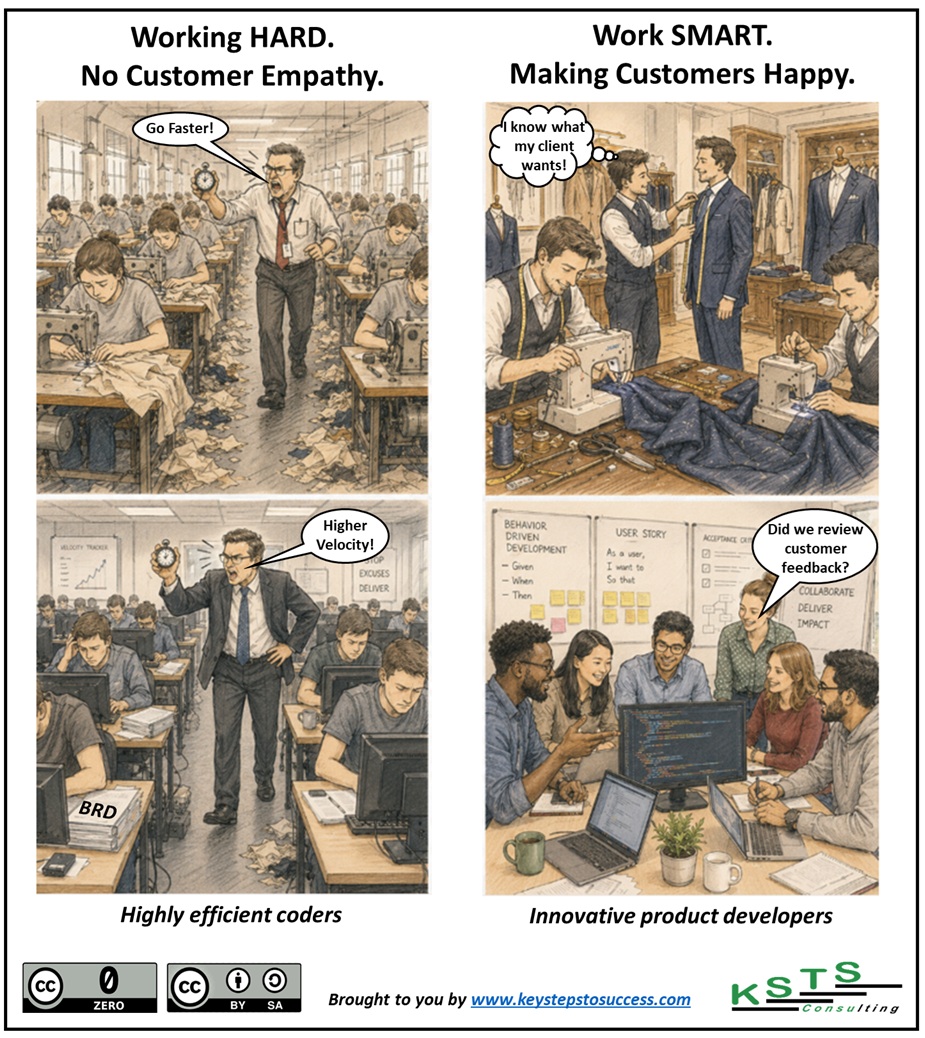
Imagine a crowded garment factory filled with exhausted workers bent over vintage sewing machines for ten or twelve hours a day. Pieces of fabric cover the floor. Every worker performs the same repetitive task with little variation or autonomy. Walking between the rows is a stern supervisor carrying a stopwatch, demanding more speed and greater output. Nobody is encouraged to think creatively. Nobody is invited to improve the process. The workers are valued primarily for how quickly they can produce standardized results.
Now replace the sewing machines with laptops. Replace the fabric patterns with massive Business Requirements Documents stacked on desks. Replace the productivity supervisor with a project manager demanding “higher velocity.”
Suddenly the resemblance becomes uncomfortable.
Many modern software organizations operate less like creative engineering environments and more like digital-era factories. Developers sit quietly in rows, heads down, implementing predefined requirements handed to them through layers of process, governance, approvals, and documentation. Their performance is often measured through output metrics, ticket counts, utilization percentages, and velocity charts. The language sounds modern and sophisticated, but the underlying management philosophy is remarkably old: maximize throughput, minimize deviation, tightly control workers, and optimize predictability.
For years, this model survived because software labor was still scarce and expensive enough that organizations could compensate for inefficiency simply by hiring more people and pushing them harder. Entire corporate cultures emerged around glorifying “hard work” — long hours, constant delivery pressure, endless backlogs, aggressive deadlines, and visible busyness. Exhaustion itself became a strange badge of honor.
But the rise of AI is beginning to expose how fragile this philosophy really is.
Artificial intelligence does not get tired while processing repetitive work. It does not complain about rewriting boilerplate code, generating test scaffolding, producing documentation, translating specifications, summarizing meetings, or handling routine implementation tasks. Much of the mechanical output that organizations spent years optimizing humans around is rapidly becoming automatable.
This changes the equation entirely.
In the industrial era, organizations rewarded people who could sustain repetitive production under pressure. In the AI era, the repetitive portion of work becomes increasingly commoditized. Simply “working harder” will no longer provide durable professional advantage because machines are already beginning to outperform humans in many forms of structured, repeatable execution.
What becomes valuable instead is judgment. Creativity becomes valuable. Systems thinking becomes valuable.
The ability to frame problems, collaborate with customers, navigate ambiguity, challenge assumptions, and combine technical knowledge with business understanding becomes exponentially more important. In other words, the future belongs far less to digital factory workers and far more to sophisticated craftsmen.
There is another world entirely — one that resembles the work of highly skilled tailors and craftsmen rather than production-line operators. In this environment, professionals collaborate directly with customers. They discuss needs, experiment with ideas, refine details, and adapt continuously. One person may be stitching intricate details by hand while another takes measurements or adjusts expensive fabric to create something unique for a specific individual. The atmosphere feels thoughtful, creative, and energized because the workers are engaged not only in execution, but also in problem solving and design.
The same distinction exists in software.
Some teams behave like digital sweatshops, where developers mechanically translate requirements documents into code while being pressured to deliver faster every quarter. Other teams operate more like collaborative product studios. Developers sit together with business users, customers, designers, and product people. Whiteboards replace rigid documentation. Conversations replace specification handoffs. Ideas evolve through experimentation rather than contract-style requirement interpretation.
Practices such as collaborative design sessions, mob programming, Behavior Driven Development, Test Driven Development, and Acceptance Test Driven Development emerge naturally in these environments because the work itself is treated as an intellectual and collaborative activity. The goal is not simply to produce code faster. The goal is to deeply understand problems and continuously refine solutions.
Ironically, these more collaborative and intellectually rich environments are also the ones most likely to thrive alongside AI rather than compete against it.
AI amplifies thoughtful teams far more effectively than it replaces them.
A highly collaborative product team can use AI to accelerate experimentation, automate routine coding, rapidly test ideas, generate scenarios, analyze customer feedback, and shorten feedback loops dramatically. In these environments, AI becomes a force multiplier for human creativity and strategic thinking.
By contrast, organizations that reduce developers into interchangeable ticket-processing resources may discover that they unintentionally optimized themselves for replacement. If a person’s primary responsibility is repetitive implementation of highly structured requirements under centralized supervision, then eventually an AI-assisted workflow will perform large portions of that role faster, cheaper, and at scale. This distinction matters far more than most organizations realize. The difference between a disengaged programming factory and a high-performing product development environment is not primarily about tools, frameworks, ceremonies, or methodologies. It is about management philosophy and organizational design. One model assumes workers should comply. The other assumes professionals should think.
One model separates “business people” from “technical people” and communicates through documents, approvals, tickets, and status reporting. The other encourages direct interaction, shared ownership, fast feedback, and collaborative discovery.
One model optimizes for predictability theater. The other optimizes for learning.
The tragedy is that many organizations publicly claim to value innovation, agility, creativity, and empowerment while internally operating with deeply industrial assumptions about work. They continue to measure success through utilization rates, reporting structures, milestone compliance, and delivery pressure while wondering why morale deteriorates and innovation slows down.
You cannot demand craftsmanship while managing people like factory labor. You cannot expect creativity from environments built around fear, control, and mechanical throughput. And you cannot prepare people for the AI era by training them merely to execute instructions faster.
The organizations and individuals who will remain relevant are not the ones who simply work harder than everyone else. They are the ones who learn faster, collaborate better, think more critically, adapt continuously, and use AI intelligently as part of their workflow.
Perhaps most importantly, writing software is not automatically intellectual work simply because computers are involved. Programming, much like sewing, exists on a spectrum. In some environments it becomes repetitive execution detached from meaning and creativity. In others it becomes a sophisticated form of collaborative craftsmanship centered around discovery, judgment, experimentation, and human interaction.
The future of software development may ultimately depend on which philosophy organizations choose to embrace. One path leads toward increasing industrialization of knowledge work, where human beings become interchangeable delivery resources managed through dashboards and output metrics until automation inevitably absorbs large portions of that work.
The other path treats software development as a professional discipline requiring trust, autonomy, collaboration, direct customer engagement, continuous learning, and intelligent partnership with AI.
The uncomfortable truth is that many technology organizations today are far closer to old manufacturing plants than they are to genuine centers of innovation. And the companies that continue confusing exhaustion with value creation may soon discover that AI does not reward the people who work hardest on repetitive tasks. It rewards the people who know how to think.