
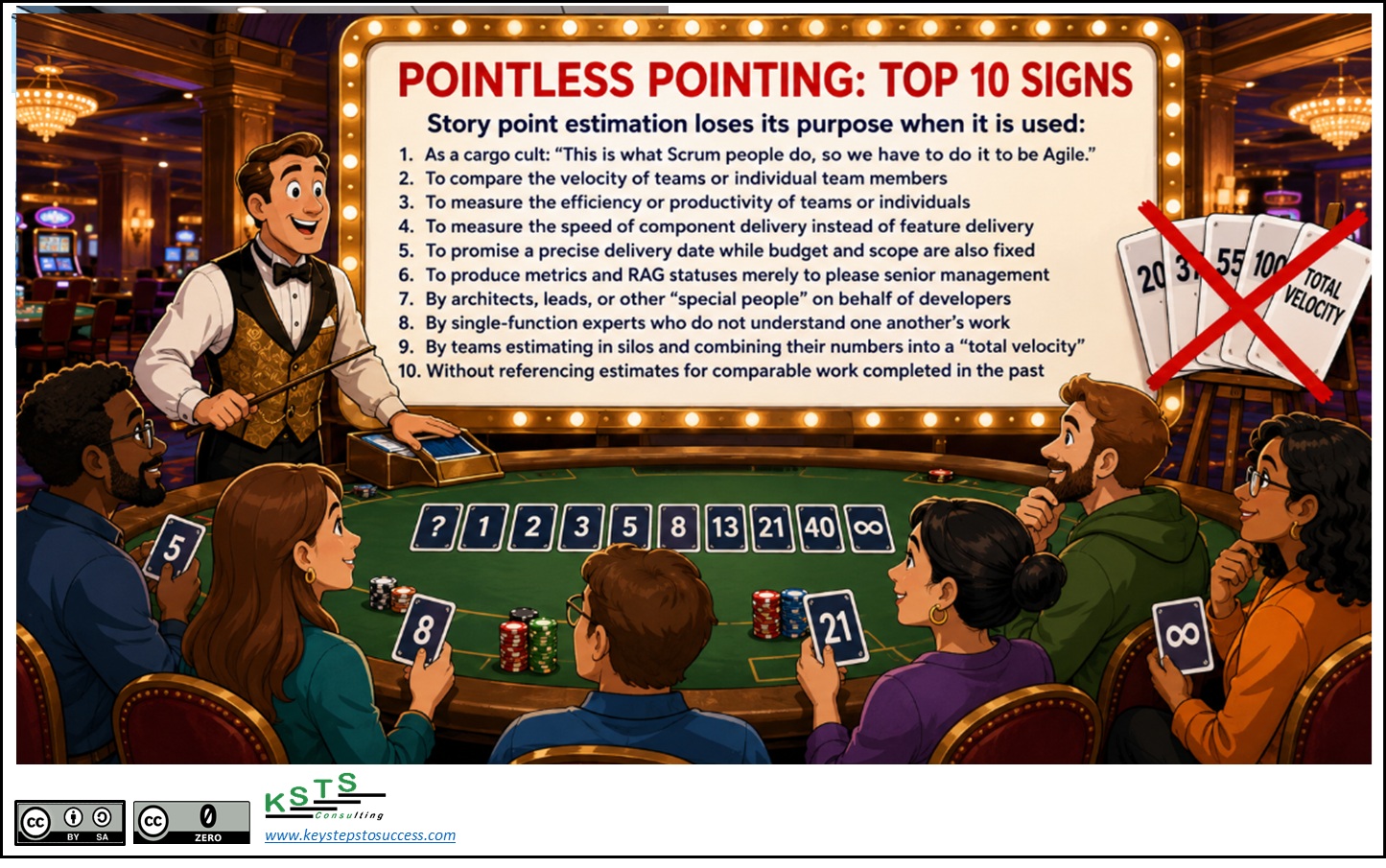
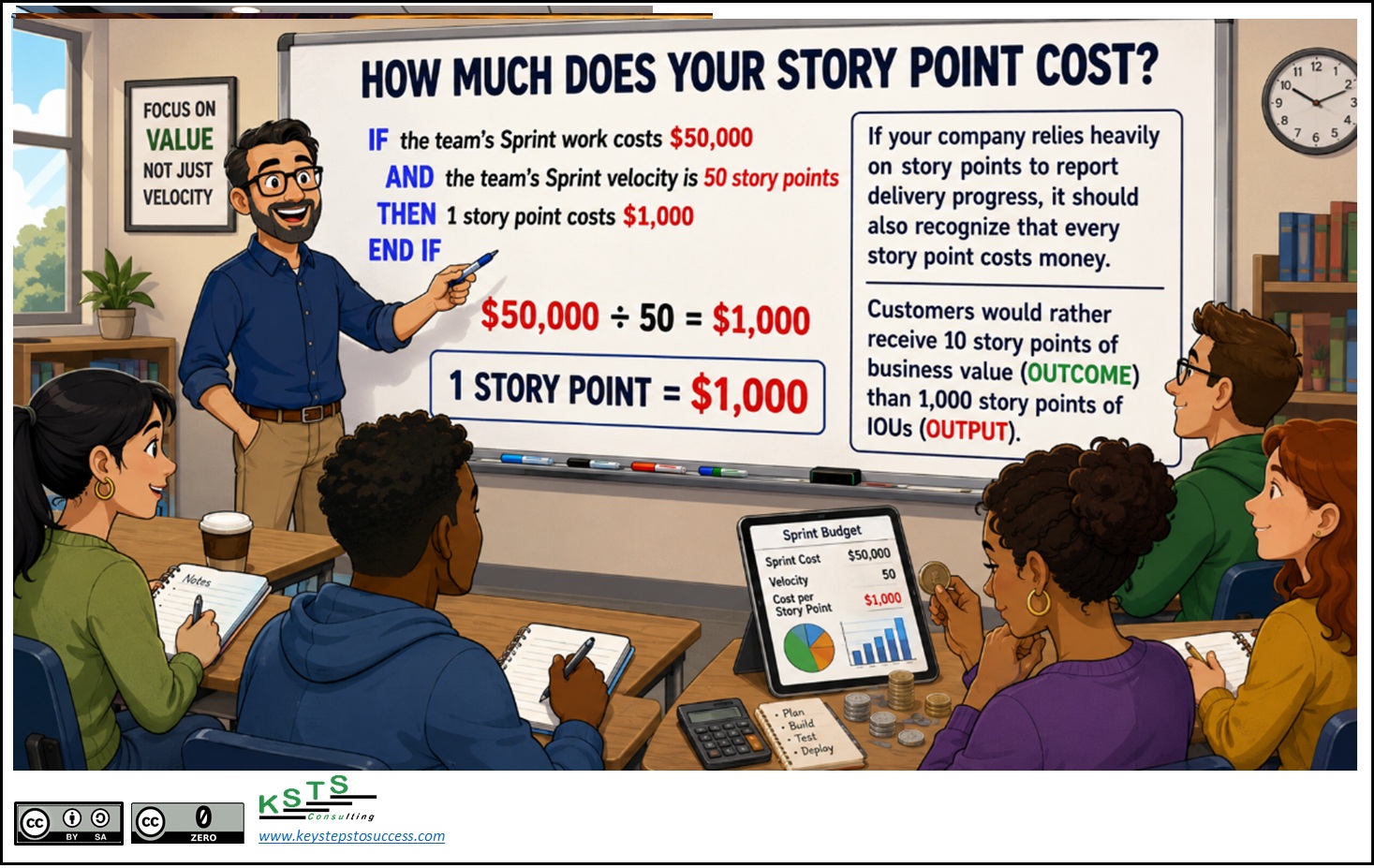
Use story points to strengthen shared understanding, support realistic forecasting, and guide delivery toward valuable product outcomes. Make sure you review the images at the bottom.
1. Establish the Right Foundation
- Build a shared conceptual understanding of relative estimation before introducing story points, so every participant understands that points express comparison rather than elapsed time.
- Use relative estimation with a collaborative team of two or more people, where normalization of different perspectives creates practical value.
- Invite the people who will perform the work to estimate it, drawing upon their direct knowledge of implementation, testing, integration, and delivery.
- Estimate as one accountable product team, with members sharing ownership for the complete result rather than estimating isolated specialist assignments.
- Cultivate a cross-functional, T-shaped team, whose members understand one another’s work sufficiently to assess the whole effort required for a usable increment.
2. Apply Story Points Purposefully
- Use story points as a team-specific measure of relative size, incorporating effort, complexity, uncertainty, risk, and necessary coordination.
- Compare backlog items against familiar reference stories, especially work that the same team has completed and delivered successfully.
- Select a simple, coarse-grained scale, such as 1–2–3, Fibonacci-style values, or small–medium–large, to promote useful distinctions rather than numerical precision.
- Treat estimation as a structured conversation, using differences in estimates to reveal assumptions, dependencies, risks, and alternative solution approaches.
- Estimate complete vertical slices of customer value, including analysis, design, development, testing, integration, documentation, and every applicable element of the Definition of Done.
- Maintain story points independently from hours and days, preserving points as a relative scale rather than converting traditional time estimates into another numerical form.
- Use task-level hours selectively when they improve near-term coordination, while retaining story points as the team’s higher-level relative estimate.
- Refine or split stories that remain difficult to estimate, producing smaller, independently valuable, testable items that satisfy INVEST principles.
- Anchor every estimate to the team’s current Definition of Done, ensuring that story points consistently reflect the complete effort required to produce a potentially shippable product increment rather than only development activities.
- Calibrate estimation regularly by reviewing completed stories, comparing original estimates with delivered work to strengthen the team’s shared understanding of relative size and improve long-term consistency without attempting to achieve perfect precision.
3. Forecast with Velocity Responsibly
- Define velocity as the amount of fully completed work delivered by one stable team during a consistent period, according to that team’s established Definition of Done.
- Use the team’s recent velocity range to support forecasting, recognizing variation across sprints and expressing forecasts as informed expectations rather than guarantees.
- Interpret velocity within the context of the team that generated it, because each team develops its own reference stories, working agreements, skills, technology, and delivery environment.
- Keep velocity as an internal planning and learning signal, enabling the team to inspect capacity, improve refinement, and make more credible sprint forecasts.
- Connect velocity to a clear Sprint Goal and a usable product increment, ensuring that completed points represent movement in a meaningful product direction rather than activity alone.
4. Emphasize Value, Learning, and System Performance
- Evaluate delivery through customer and product outcomes alongside velocity, giving equal attention to usability, quality, learning, strategic progress, and stakeholder value.
- Use throughput or completed-item counts when work items are consistently small and similarly sized, particularly in flow-based or Kanban environments where counting offers a simpler forecast.
- Pair estimation data with flow and system evidence, such as cycle time, lead time, work in progress, dependencies, and impediments, to explain how value actually moves through the organization.
- Review estimation practices regularly as a team, adapting scales, reference stories, refinement methods, and forecasting assumptions as experience accumulates.
- Protect estimation as a psychologically safe professional judgment, encouraging honest uncertainty, balanced participation, and estimates created solely to improve shared understanding and delivery decisions.
Story points and velocity are most effective as local learning and forecasting instruments, while product outcomes and usable increments remain the primary evidence of progress. This emphasis also aligns with the latest directive to communicate recommendations affirmatively and decisively.
 |
 |
 |
 |