Organizations rarely transform in a single step. While many aspire to become product-centric and fully aligned around business value, most still operate within familiar constructs—portfolios, programs, projects, annual budgets, and governance checkpoints. This creates a natural tension: the desire to move faster and adapt continuously, while still maintaining structure, predictability, and control.
Lean Portfolio Management (LPM) emerges in this space not as a replacement imposed overnight, but as a transitional and connective layer. It allows organizations to begin shifting their thinking—from managing work as discrete initiatives toward managing it as a continuous flow of value—without requiring an immediate abandonment of existing portfolio constructs.
Click on the image above to enlarge
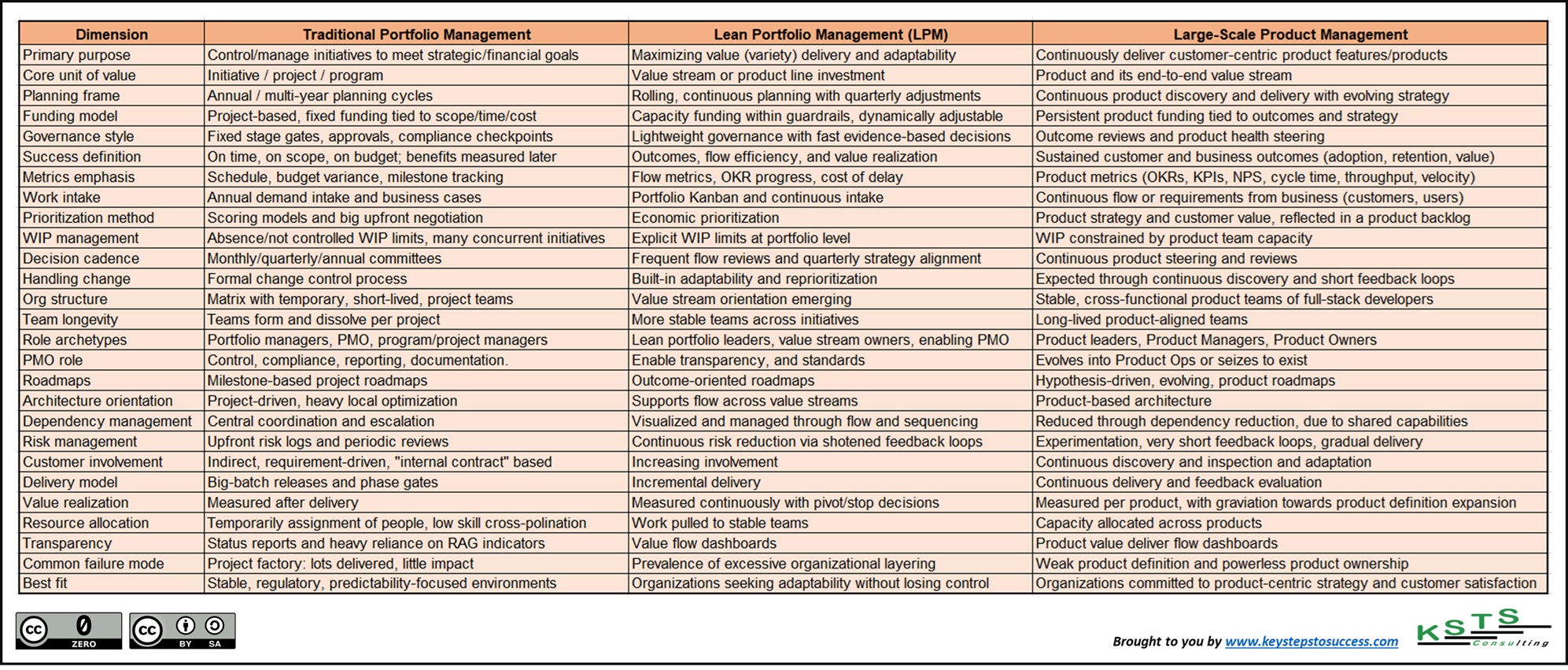
At its core, LPM reframes how strategy is translated into execution. Traditional portfolio management tends to organize work around initiatives that are approved, funded, and tracked against predefined scope, time, and budget. Success is often measured after delivery, based on adherence to plan. LPM, by contrast, introduces a different orientation. It treats work as part of a system of value streams, where ideas are continuously discovered, evaluated, and implemented, and where success is tied to outcomes, flow, and realized value rather than conformance to initial plans.
This shift is subtle but profound. Planning becomes less about committing to a fixed future and more about establishing direction with the ability to adjust along the way. Funding evolves from being tightly coupled to individual projects toward supporting capacity within value streams, allowing organizations to respond to changing priorities without the friction of constant re-approval cycles. Governance, in turn, becomes lighter—not in the sense of losing control, but in replacing heavy stage gates with more frequent, evidence-based decision points.
When viewed alongside traditional portfolio management and modern product management, LPM sits somewhere in between. It retains elements of structure and oversight that organizations still depend on, yet begins to introduce concepts that are more aligned with product thinking. Instead of large batches of work moving through phase gates, work is visualized and managed through a portfolio-level flow—often represented as a Kanban system—where initiatives evolve from ideas into validated efforts and, ultimately, into delivery.
Click on the image above to enlarge
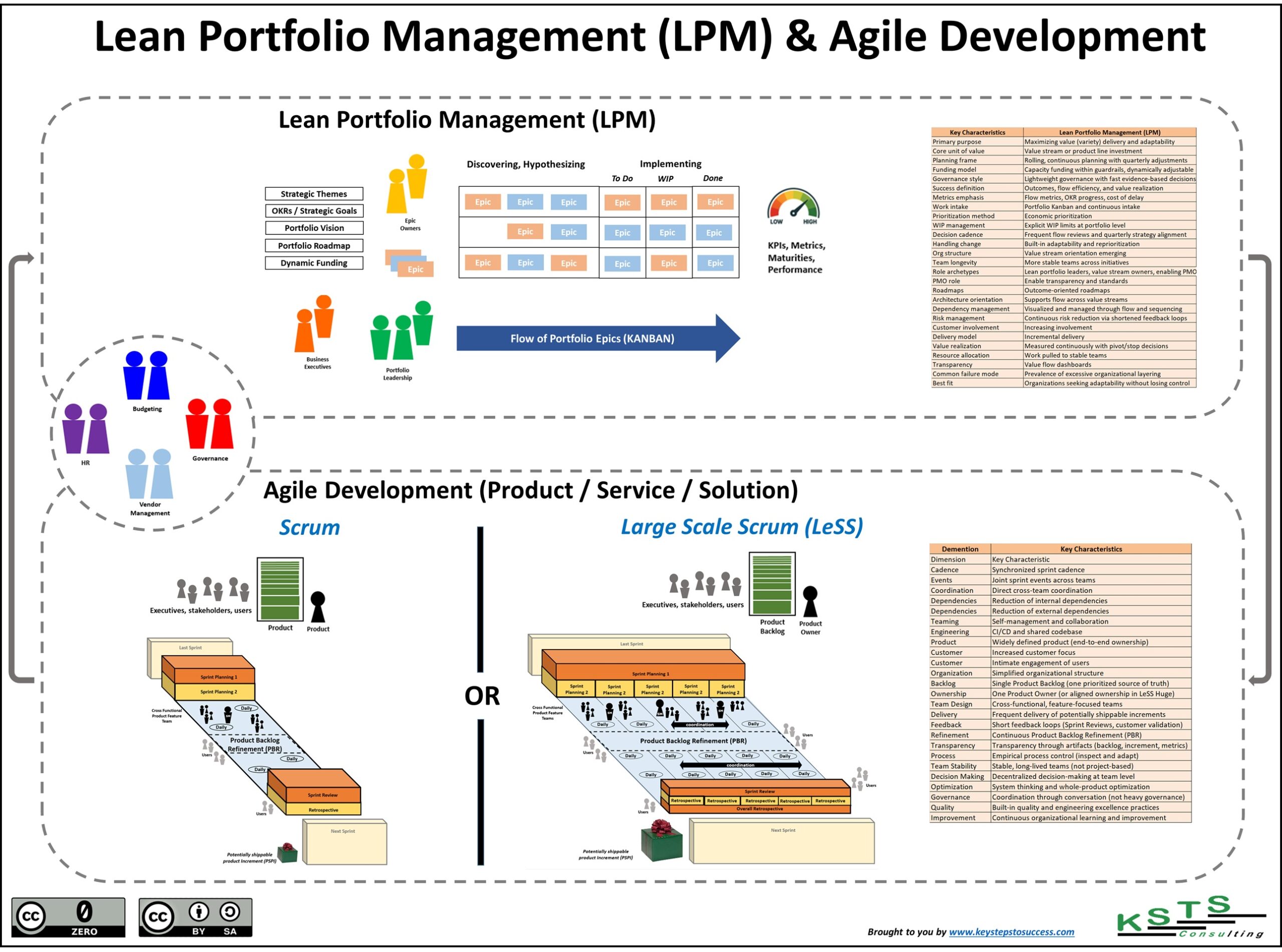
This is where LPM connects directly with agile delivery models such as Scrum or Large-Scale Scrum (LeSS). The portfolio does not operate in isolation; it feeds into the teams responsible for building and delivering products or services. At the portfolio level, strategic themes, objectives, and priorities shape what enters the system. As work moves forward, it is broken down and executed by teams working iteratively, using Scrum for single-team contexts or LeSS when multiple teams collaborate on a shared product.
The relationship between these layers is continuous rather than hierarchical. Portfolio decisions guide execution, but execution also informs portfolio decisions. Feedback from delivery—customer response, cycle times, throughput, and other indicators—flows back upward, influencing what is prioritized, adjusted, or stopped altogether. In this way, strategy and execution become part of a single, evolving system rather than two disconnected domains.
This approach is particularly relevant for organizations that are not yet ready to fully abandon portfolios and projects, but are consciously trying to move in that direction. In such environments, LPM provides a way to introduce adaptability without removing necessary constraints. It allows leaders to maintain visibility and governance while gradually shifting emphasis toward outcomes, flow, and customer value.
Over time, the effects of this shift become more visible. Decision-making tends to happen more frequently and with better information. Teams become more stable and aligned around longer-lived efforts rather than temporary projects. Metrics evolve from tracking milestones and budget variance to understanding flow efficiency, value delivery, and customer impact. Perhaps most importantly, the organization begins to develop the ability to change direction without significant disruption, because change is no longer treated as an exception—it is built into the system.
Lean Portfolio Management, therefore, is less about implementing a new framework and more about evolving how an organization thinks about work, investment, and value. It acknowledges where most organizations are today and provides a path forward—one that gradually shifts from control and predictability toward adaptability and continuous delivery, while still respecting the realities of governance, funding, and organizational structure.
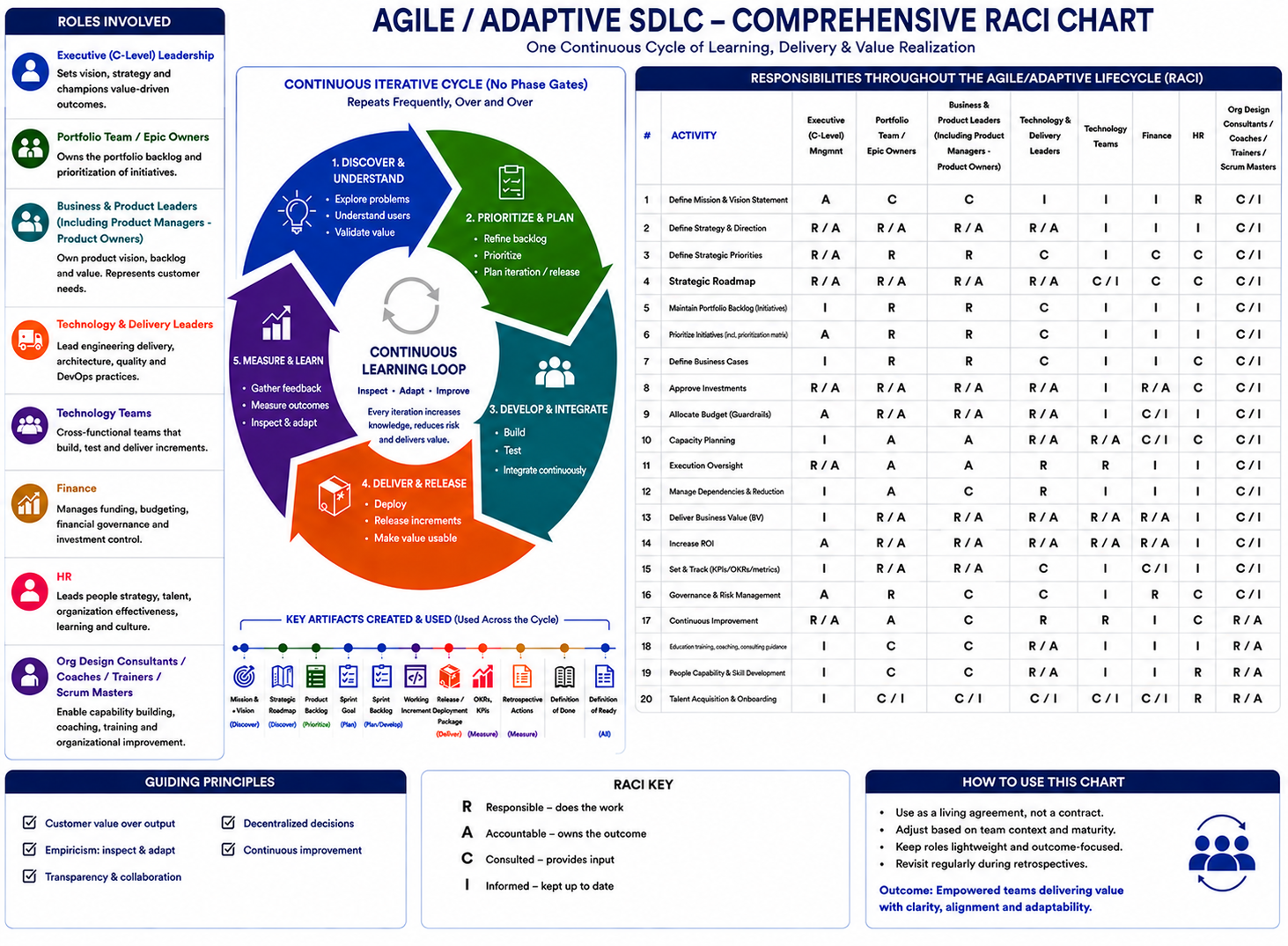
Suggested LPM RACI