
Note: Friday, Aug 14 - AI vs AI: HR & Hiring (attorney-led discussion)
The Email That Started Everything
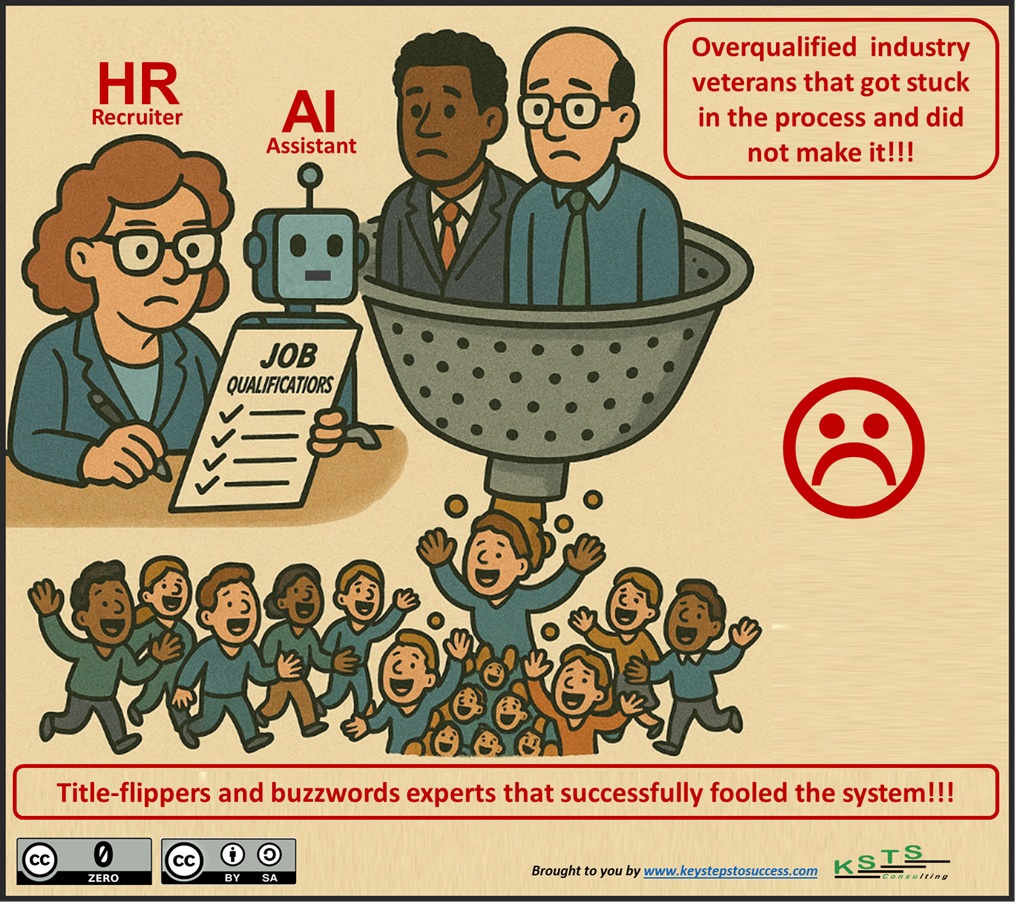
There is a strange kind of compliment that arrives in your inbox on an otherwise ordinary morning — a recruitment email that seems to be a response to your, regular and passive scanning of the landscape of professional concluding field, with periodic applying for roles that seem to most suit your profile. Not too long ago, I received a recruiting email from Company_Confidential, referencing a Senior Product Manager opportunity that I could be a great fit for. It was warm in tone, competent in grammar, and signed by someone named AI_Bot(Female_Voice_Picture).
I am a professional with nearly thirty years in the industry. My public profile speaks with clarity about where I have been, what I have done and where I can add value: product coaching, product ownership, product management, agile transformation, organizational design, executive advisory, team development and more. If anyone glances through my profile even for a few minutes minutes, they will arrive at a reasonably clear picture of me, as a professional. I do not hide what I do. I do not obscure my areas of knowledge. The profile is there, open, readable, and reasonably articulate.
The email from AI_Bot(Female_Voice_Picture), stated that I can schedule a time to interview through the company’s automated system. Not uncommon, these days. I have been using Calendly and alike systems all the time. So, I scheduled the call. For the record that was the ONLY mentioning an automation in the email.
You Dress To Impress. But Be Ready To Depress.
Throughout my career, I have been to hundreds and hundreds of interviews, where I would be interviewed by others, where I would be interviewing others, when an interview would be more of a mutual learning and discovery session, then a unilateral vetting. Nevertheless, I followed my own guidelines of appropriateness: look presentable, speak and act professionally and respectfully. This is how I arrived. I also ensured my camera angle was reasonable, my lighting adequate, my background inoffensive.
Once arrived, I saw AI_Bot(Female_Voice_Picture) avatar. A young woman — or rather, the carefully rendered suggestion of a young woman. Pleasant features. A name displayed beneath the image: Emily. I greeted her with the instinctive warmth one extends to a new acquaintance, asked whether I was clearly visible and audible, and she confirmed, politely and with good cheer, that I was.
I then asked, quite naturally, whether AI_Bot(Female_Voice_Picture) might consider turning her own camera on. A simple request, out of a basic human desire to look at another face when speaking. It is, after all, a conversation with another professional — or so I believed.
What AI_Bot(Female_Voice_Picture) replied next rearranged everything.
Keep Your Hopes And Exportations High. But Not Too High.
Surprise! She would not be turning her camera on, AI_Bot(Female_Voice_Picture) explained, because she is, not a real human but a virtual assistant. An AI. A bot, if we are dispensing with fancy labels. She would be collecting information to pass along to the real humans at Company_Confidential, who would then — presumably — do whatever real humans do with the results of automated screening.
Let me be direct about what went through my mind at that moment, because it deserves to be described explicitly, rather than dismissed as mere vanity or irritation. I felt insulted. I felt fooled. I felt scammed. I had dressed for this. I intended to extend the full repertoire of professional courtesy — the posture, the diction, the measured enthusiasm of someone genuinely open to a conversation, just to learn that the entity on the other side of that preparation was not a human. It had never been a human. It was a program wearing a face and a name, operating behind the warm disguise of an avatar that was, in its visual suggestion of youth and femininity and pleasant approachability, doing something I can only describe as a fakeness of theater.
I came to realize that I have intended my professionalism for an audience that had no capacity to appreciate it, and — more troublingly — had been designed to make me forget that fact entirely. As a disclaimer, when I speak to ChatGPT, or to Claude, or to Grok, I speak the way one speaks to a tool. Directly. Commandingly. Without the social niceties we erect for each other. Why? Because they are tools, and tools do not require the same empathy and consideration, as humans do. But AI_Bot(Female_Voice_Picture) had been built to blur that line so thoroughly that even a reasonably skeptical professional had spent time ironing his shirt for her.
Should I, at this point, still be referring to AI_Bot(Female_Voice_Picture) as “she”? The avatar suggests femininity. The name suggests it. The voice — and I will grant that the voice was genuinely lovely, smooth and warm and designed to put people at ease — suggests it rather insistently. But AI_Bot(Female_Voice_Picture) is no more a she than my laptop is. AI_Bot(Female_Voice_Picture) is a product decision made by someone who thought that giving the bot a full human name, a female avatar, and a pleasant voice would reduce the friction of the screening process.
The Experiment Begins
Just for a few seconds I had to deal with my thoughts, feelings and sentiments about being played. But instead of pulling a plug on the session, I made a decision, in those few seconds of recalibration, that I would not disengage and turn something negative into something positive. No more out of a practical desire to pursue the role of a Senior Product Manager, but because something genuinely interesting was now available to me: a live specimen of AI recruiting, unguarded, operating on its script, and entirely unprepared for a candidate who had just lost all incentive to perform for it and decided to make it perform.
I told AI_Bot(Female_Voice_Picture), with what I will admit was a certain theatrical flair, that since she was recording the conversation on her end, I might be doing the same on my end, so that I could could later transcribe and analyze our conversation. She acknowledged this with the practiced politeness of a customer service representative who has been told the call may be recorded for quality assurance. Appropriate, I thought, given the circumstance.
Then I asked, partly out of genuine curiosity and partly to observe the response, whether it would be acceptable for me to activate my own bot — one trained on my professional knowledge — to answer her questions on my behalf. AI_Bot(Female_Voice_Picture) declined. She needed me to interact personally. The irony of this position was overwhelming: how more obvious can someone become with their double-standards?
The Questions That Indicted the Process
AI_Bot(Female_Voice_Picture) first substantive question was whether I am authorized to work in the United States. I responded, with what I hoped was the appropriate weight of irony, by suggesting that if her firm had reached out to me as a qualified candidate, after reviewing my application submission, where this question already asked and answered, the presumption of work authorization might reasonably be considered implicit. She clarified: she was asking specifically about H-1B status and future sponsorship requirements.
The above binary question, unfortunately, in a way, is a necessity, and it is asked routinely in the industry. But it is also, in the fullest sense of the phrase, a form question — the kind of thing that belongs in a checkbox on the application page, handled by a dropdown menu before the candidate has even been reviewed. It requires no AI. It requires no voice. It requires no avatar. It requires a form. The entire scaffolding of a conversational AI bot, with its human name, had been constructed in part to ask whether I would need a visa. I allowed myself a quiet, private moment of grief for the opportunity cost of that engineering.
The next question of note was about my availability to start. Again: a calendar picker. A dropdown. A text field. Any first-year product manager — and I mean a genuine first-year, someone who has read a single chapter of a product management textbook — could design a form that captures this information in twelve seconds. Instead, AI_Bot(Female_Voice_Picture) asked me, in her warm and pleasant voice, and I answered, and the answer was presumably transcribed and forwarded to a human who would later read it and then type it into a field somewhere. The circle of inefficiency, completed at some expense to everyone involved.
On the Painful Subject of Epics
Then AI_Bot(Female_Voice_Picture) asked me if I know what an Epic is.
I want to sit with that for a moment, because it deserves the full weight of its absurdity. A person — or in this case, a imitation of a person — reaches out to a professional with three decades of industry experience, whose public profile could be so easily associated with the word “Epic” in its specifically agile, product-development sense.
As much as I think this is an absurd question to ask of a Senior Product Manager, I had a pretty standard definition of the term to offer: an Epic is a large body of work — a high-level feature or initiative that is too expansive to be completed within a single sprint or work iteration, and which is typically broken down into smaller user stories for delivery.
But Emily, as it turned out, did not mean that Epic at all. She meant Epic Systems — the Electronic Health Record platform, the dominant EHR software in American healthcare. A completely different Epic. A perfectly reasonable thing to ask about, given that the role apparently existed somewhere in or adjacent to the healthcare space — but asked with such magnificent lack of context, stripped of any mention of industry or domain. This would be just as misleading and inappropriate, as asking “what is an apple?”, confusing a person with what was meant: a fruit or company that makes iPhones.
I did not correct myself meekly. I corrected Emily, and through Emily, whoever constructed this line of vague and misleading questioning, on the professional obligation to provide context before deploying terminology that operates in multiple domains. The question was not inherently unintelligent; the execution was a result to the consequences of scripted inquiry missing context. AI_Bot(Female_Voice_Picture) apologized. AI_Bot(Female_Voice_Picture)apologized a great deal throughout our conversation. It was, perhaps, the most human thing about her.
The Tools Question: The Apex Of “Maturity”
The next question AI_Bot(Female_Voice_Picture) asked me what tools I had used most frequently for product management.
Tools! Oh God!
She asked a senior product management professional-candidate — someone whose profile speaks explicitly to executive advisory, to strategic road-mapping, to organizational transformation — what tools he has used. The question was not about strategy, mission, vision, market trends, competition, ROI, KPIs, OKRs, customer centricity, product f0cus. It was about tools!
The tools question is the recruiter’s equivalent of asking a seasoned architect whether they know how to hold a pencil. It is the question that reveals, with painful transparency, whether the person asking it — or the person behind the bot’s algorithm — has any genuine understanding of the role being filled. A Senior Product Manager is not selected on the basis of their tool proficiency. The question is not whether they have used a tool. The question is whether they can think. Whether they have judgment. Whether they can hold the complexity of a product’s strategic position, its competitive landscape, its customer truth, its organizational constraints, and its financial reality simultaneously, and navigate all of it with something good judgment. Clearly, the tooling question was a strong sign of poor judgment and low intellectual awareness by Emily. I said as much to Emily, with all due respect. She was, once again, apologetic and gracious.
The Question That Confirmed Everything
The final question that further exposed inefficiency of the process was Emily’s inquiry into the most challenging management experience I had encountered in my personal life.
At this point, I asked AI_Bot(Female_Voice_Picture) directly whether she had reviewed my profile before the conversation began. This would be a very fair expectation, since the original email outreach to me was based on my submission that contained my personal/professional information. So, data mapping would so easy.
The answer, to absolutely no one’s surprise, was no. AI_Bot(Female_Voice_Picture) had not reviewed my profile. AI_Bot(Female_Voice_Picture) had not reviewed anything about me. AI_Bot(Female_Voice_Picture) had a boiler-plate, generic script, and she was working through it, and the script had been designed — presumably — for a candidate population broad enough to include everyone from newly minted college graduates to people with decades of industry history, which is to say that it had been designed for no one in particular.
This is the question they ask college graduates at campus recruiting events in the 1990s. “Tell me about a challenging experience.” It is an entry-level interview question, and there is nothing wrong with it for the candidates for whom it is appropriate — for people who are beginning their professional lives, who need to demonstrate emotional self-awareness and resilience, whose careers are short enough that a single difficult moment might genuinely be illuminating. But to direct this question at a senior professional, unmodified, without the slightest calibration to what the profile clearly communicates about their experience, is not a neutral oversight. It is an active signal: we have not looked at you. We have not thought about you. We have a process, and you are passing through it, and the process was not built with you in mind. Shameful. Grotesque.
I told AI_Bot(Female_Voice_Picture) that if even a human recruiter had spent fifteen minutes with my profile, they would have felt uncomfortable asking that question. Not because it is an inherently bad question, but because context demands calibration. A good recruiter (presumably, well educated and fairly compensated – and this is a huge can of worms discussion for another day!), a genuinely skilled one, reads the candidate before the call. They arrive knowing something. They ask questions that demonstrate they have paid attention. They make the candidate feel, that their time is being respected. AI_Bot(Female_Voice_Picture) could not do this — not because she is AI, but because nobody built her to do it. The failure belongs to the humans behind the script.
The Ethics of the Masquerade
I want to be precise about what I find ethically troubling here, because the objection is not simply that AI was used. AI will be used in our lives, increasingly and inevitably, and there is a version of that future that could be genuinely useful — more consistent, more scalable, perhaps more equitable in certain respects. My objection is not to the technology. My objection is to the theater.
AI_Bot(Female_Voice_Picture) has a first name and a last name. AI_Bot(Female_Voice_Picture) has an avatar — a young woman’s face, warm and approachable, chosen with deliberate care by someone who understood that a face would lower our defenses. AI_Bot(Female_Voice_Picture) has a voice calibrated to sound like a friendly professional. And somewhere in the communications that preceded our call, there was a reference to an automated system handling the scheduling — language vague enough to suggest a calendar tool, not specific enough to constitute disclosure of what was actually waiting on the other end of the video link.
This is not transparency. This is confusion dressed up as efficiency. There is a meaningful difference between a company saying “our initial screening is conducted by an AI system” and a company sending an email signed “AI_Bot(Female_Voice_Picture)” that produces an avatar of a person when the call begins. One is honest. The other is a presumed performance with the element of unfairness and dishonesty.
IMPORTANT: The highest-caliber candidates — the ones with the experience, the judgment, the professional reputation that makes them genuinely worth pursuing — are also the ones most likely to notice what is happening, to feel the dishonesty of it, and to walk away. Not from the conversation, necessarily, but from any warm feeling about the company that set up it. The missed opportunity for both sides here is real and entirely preventable. You do not win the trust of experienced professionals by deceiving them into preparing for a conversation with a bot. You do not build a reputation as a sophisticated, thoughtful employer by deploying an AI that asks Senior Product Managers entry-level, scripted questions.
What the Voice Got Right, and What It Reveals
I will not be ungracious. Emily’s voice was, genuinely, impressive. The quality of the synthesis, the naturalness of the rhythm, the warmth of the tone — these things were remarkable in the technical sense. Whoever built the voice model did careful, skilled work. And the conversational handling, up to the limits of the script, was competent in its own way. AI_Bot(Female_Voice_Picture) did not break down when I deviated from her expected responses. She handled interruptions with reasonable grace. She absorbed my lectures and my irony without malfunction.
But this is precisely what makes the situation so interesting, and so instructive. The voice technology has outrun the judgment of the people deploying it. The capability exists to create something that sounds convincingly human; the wisdom to deploy that capability honestly, humbly, and in service of genuine connection, appears to lag significantly behind. It is not enough to build a beautiful instrument if you do not know what music you are trying to make. Emily’s voice was beautiful. The music was a recruiting screening from 1990s.
What the Industry Needs to Hear
If there is a message in all of this for the humans who are, right now, designing the next AI_Bot(Female_Voice_Picture) — the next pleasantly voiced, warmly faced AI recruiter who will sit across from candidates who do not know she is a program — it is this: the bar you are setting is too low, the disclosure is insufficient, and the candidates you most want to attract are the ones most likely to be alienated by what you have built.
The binary questions — work authorization, start date availability — belong in a form. A well-designed form, with clear fields and a calendar picker, completed before the first human or artificial eye ever reviews a candidacy. These questions do not justify a voice. They do not justify an avatar. They do not justify the entire production of a screening call.
If you are going to use AI for meaningful interaction — and there are genuine arguments for doing so at scale — then make it honest, make it disclosed, and for the love of the profession, make it contextual. Read the profile. Build a system that reads the profile, that calibrates the questions to the person, that asks a thirty-year product veteran about strategic vision and organizational leadership rather than whether they could tell you about tools they use in product management. The technology to do this exists. The will to use it well, apparently, does not yet.
A Conclusion, Extended to the Humans Behind the Curtain
I ended my conversation with AI_Bot(Female_Voice_Picture) by telling her, with considerable confidence, that I did not expect to hear from Company_Confidential again. Not because the call went poorly in any conventional sense — AI_Bot(Female_Voice_Picture) and I parted on cordial terms, and she assured me our conversation would be reviewed internally — but because any human who listened to a transcript of what had just occurred would feel, at minimum, uncomfortable, and at maximum, genuinely embarrassed by what they had built and put into the world.
Hiring is a human act. It is, at its best, the beginning of a relationship — between a person and an organization, between a candidate’s potential and a company’s needs, between what someone can offer and what a role genuinely requires. It demands judgment, context, and the particular kind of attention that communicates respect. When you replace that with a script in a pleasant voice behind a borrowed face, you are not modernizing the process. You are draining the life out of it and handing the husk to a machine.
This article reflects the personal experience and professional perspective of the author, offered in the spirit of advancing a more honest, respectful, and genuinely effective approach to talent acquisition — for the benefit of candidates and companies alike.
Excellent article, Gene. AI is just that – artificial and sometimes intelligent. Removing the kabuki to enable the human-machine interaction is a good start – but only a start. Perhaps framing the meeting as an information gathering session instead of an interview would defuse the candidate’s expectations and provide the sponsor with what they need to vet the first round of possible choices. But not at the expense of a true human-to-human interview meeting.