
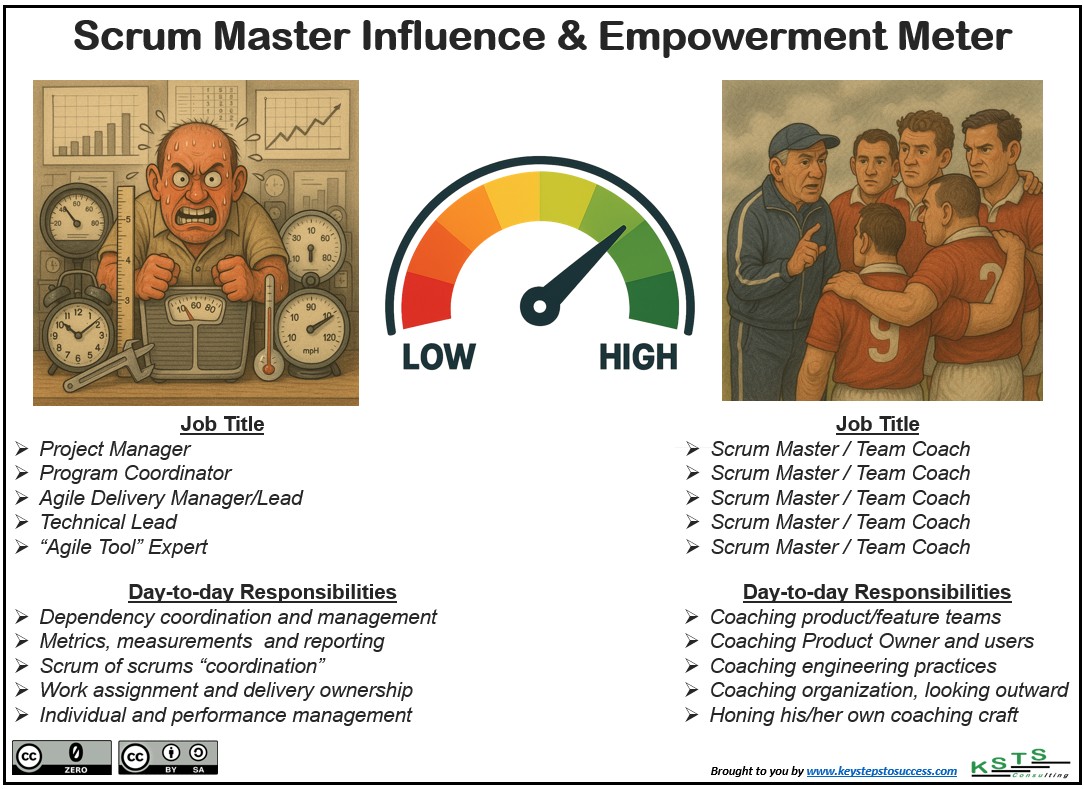
Meet “Scrum Master” #1 — The Miscast One
There is a version of the Scrum Master role that many organizations know all too well, even if they don’t openly admit it. This is the “Scrum Master” who was never really intended to become one in the first place. Typically, this person comes from more traditional environments and titles — Project Manager, Program Coordinator, Agile Delivery Lead, Technical Lead, or perhaps someone deeply specialized in agile tooling and reporting systems.
To be fair, many of these roles are not inherently bad. In the right environment, they can be extremely valuable. The problem is not the people themselves — it’s the mindset and operating model those roles were originally designed for. Most were optimized for coordination-heavy structures, command-and-control delivery models, timeline enforcement, reporting, resource management, and executive visibility. They were not designed around coaching, enabling, mentoring, or helping teams become genuinely self-managing. And that distinction matters far more than many companies realize.
When you look closely at what these “Scrum Masters” spend most of their days doing, a certain pattern emerges. They manage dependencies. They generate dashboards and progress reports. They host status-heavy Scrum-of-Scrums meetings rather than facilitate meaningful collaboration. They assign work, track utilization, monitor timelines, chase deliverables, and often act as informal performance overseers.
At that point, it becomes fair to ask an uncomfortable question: where exactly is the coaching? Where is the work of helping teams become stronger, more collaborative, and more adaptive? Where is the support for Product Owners trying to maximize product value? Where is the effort spent addressing organizational dysfunctions, systemic bottlenecks, unhealthy incentives, or cultural impediments?
Most of the time, it simply is not there.
Because this version of the Scrum Master is not really functioning as a Scrum Master at all. More often, they are operating as delivery coordinators, schedule enforcers, reporting administrators, or middle managers trying to remain relevant inside organizations that are attempting to modernize without fundamentally changing how they think. And yet, many companies continue to create these roles after sending someone through a quick certification class, checking an organizational box, and declaring progress. Another title update. Another workshop completed. Another budget item spent in the name of “transformation.” Unfortunately, very little actual capability gets built this way. This is one of the most common forms of transactional agility — expensive, superficial, and incredibly widespread.
✅ The Right Choice: The True Scrum Master / Team Coach
Now let’s look at the other version of the role — the one that actually aligns with lean, agile ways of working.
This person usually does not need to be retrofitted into the role. Their identity, focus, and professional orientation already align with what the organization genuinely needs. Their title may literally be Scrum Master or Team Coach, but more importantly, their day-to-day behavior reflects it. They are not there to manage agility. They are there to enable it. A true Scrum Master or Team Coach spends far less time obsessing over task tracking and far more time investing in people, interactions, team dynamics, product thinking, and organizational learning. Their work often revolves around helping cross-functional teams collaborate more effectively, coaching Product Owners toward stronger product thinking and clearer prioritization, supporting developers in improving engineering practices, and helping leadership understand how their own behaviors either enable or suppress agility. They continuously sharpen their own coaching craft because they understand that this work is not administrative — it is deeply human. You rarely see these individuals obsessing over story-point accounting or sending calendar reminders for stand-ups. Instead, they are identifying dysfunctions that others avoid discussing. They challenge complacency. They surface uncomfortable truths. They create space for continuous improvement instead of merely administering process compliance. Most importantly, they understand a subtle but critical distinction: they do not “run Scrum.” They cultivate an environment where better ways of working can emerge and sustain themselves. That difference is enormous.
🎭 The Corporate Irony
The irony in all of this is difficult to ignore.
In many organizations, Scrum Master positions quietly become landing spots for leftover roles — people displaced by reorganizations, project managers searching for continuity, coordinators trying to remain close to delivery execution, or individuals whose prior responsibilities have become less relevant in changing environments. Naturally, many of those individuals struggle in the role. Not because they are incapable people, but because they were never truly prepared, empowered, or positioned to function as organizational coaches and enablers of change. But instead of recognizing the mismatch, organizations often blame the framework itself. “We tried Scrum. It didn’t work here.” “Lean, agile ways of working sound good in theory, but our culture is different.” “That approach works for tech companies, not for us.” We have all heard variations of these statements countless times.
But the reality is much simpler and far less mysterious. If an organization starts with the wrong ingredients, it should not be surprised when the outcome disappoints. No framework, methodology, or operating model can compensate for poor role alignment, weak organizational intent, or superficial implementation.
🔄 Garbage In, Garbage Out — Politely Put
Real transformation is not achieved through role reshuffling or corporate theater. Organizations cannot simply move people into critical positions, rename them, and expect meaningful behavioral change to magically emerge. Lean, agile ways of working require thoughtful investment in the right people, the right coaching capabilities, and the right organizational environment. The level of seriousness with which a company approaches the Scrum Master role often becomes a direct reflection of how seriously it approaches transformation itself. If the role is trivialized into ticket administration, meeting coordination, or reporting overhead, the broader transformation effort usually follows the same path — shallow, performative, and unsustainable. But when organizations genuinely invest in capable coaches who can influence systems, mentor teams, challenge leadership thinking, and enable learning, the results become very different. This is not simply about hiring “good Scrum Masters.” It is about recognizing that meaningful organizational change requires leadership, courage, facilitation, and systems thinking — not just logistics and coordination.
🎯 Final Thoughts
If Scrum Masters inside an organization are struggling to enable meaningful change, it may be worth pausing before blaming the framework itself. Instead, organizations should ask harder questions. Were the right people selected for the role? Were they empowered to challenge the system? Were they developed as coaches rather than coordinators? Was the organization actually prepared to support lean, agile ways of working beyond ceremonies and terminology? Because frameworks alone do not create transformation. People do. And the people placed into critical enabling roles shape the outcome far more than any slide deck, certification, or process diagram ever will.
So perhaps it is time to stop treating Scrum Master positions as organizational leftovers, administrative conveniences, or symbolic gestures. Perhaps it is time to start viewing them as what they were always intended to be: catalysts for meaningful change.