
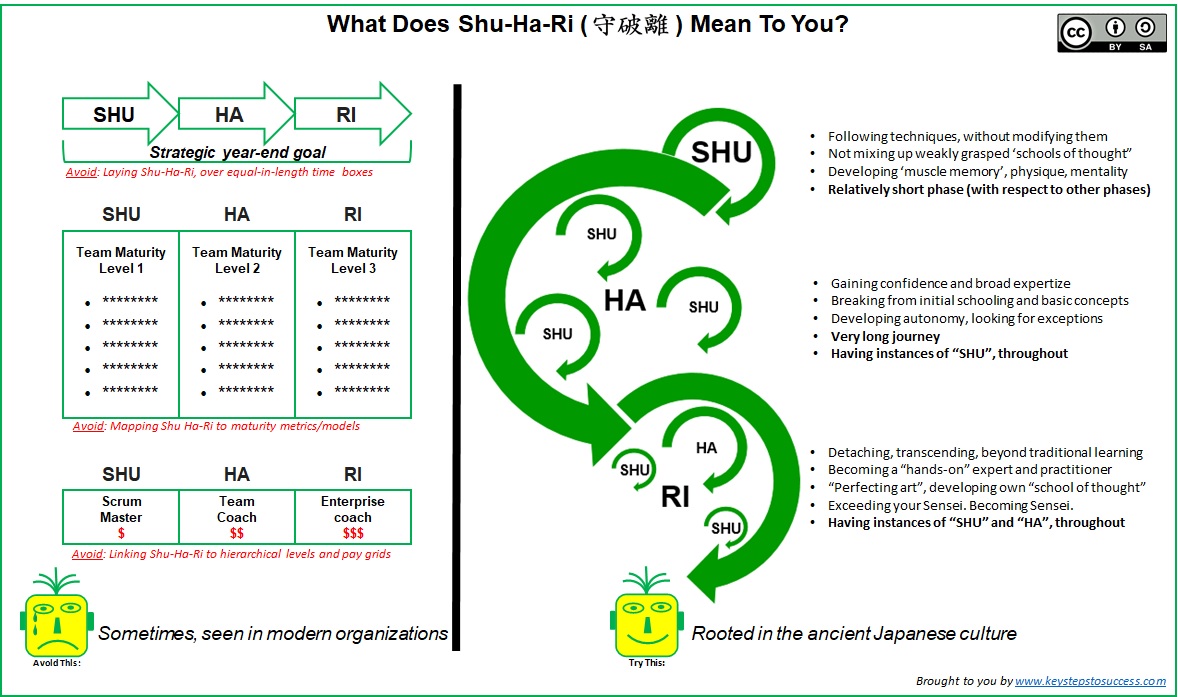
There is a certain comfort in that interpretation. It aligns with how modern organizations prefer to think—structured, measurable, predictable. But in doing so, something essential is lost.
Because Shu–Ha–Ri was never meant to be linear.
Its roots lie in ancient Japanese culture, where mastery was not viewed as a straight path forward, but as a deepening relationship with practice. Not a climb, but a continuous unfolding. Not a progression you complete, but a cycle you revisit.
At the beginning, there is Shu. This is the stage of following. Of discipline. Of imitation. There is something almost humbling about it, because it requires surrender. You follow the form as it is given. You do not modify it. You do not mix it with other approaches. You do not yet try to be creative. Instead, you repeat, and repeat again, until something begins to settle—not just in your mind, but in your body. Patterns form. Habits take shape. What once felt foreign starts to feel familiar.
There is a quiet strength in this phase, though it is often underestimated. Many people rush through it, eager to “move on,” not realizing that without this foundation, everything that follows becomes fragile. Shu is not about obedience for its own sake. It is about building a base strong enough to support future freedom.
And then, almost inevitably, something begins to shift.
Ha emerges not as a rejection of Shu, but as a natural evolution of it. Confidence grows. Questions arise. You begin to see not just the form, but the principles behind the form. And once you see that, it becomes difficult to simply follow without thinking.
This is where exploration begins.
In Ha, you start to experiment. You adapt. You test boundaries. You look for exceptions. You begin to develop your own judgment. It is no longer enough to do things “the right way”—you want to understand why that way exists in the first place, and whether it always applies.
This phase can be long. Much longer than people expect. It is not a clean transition from one state to another, but a prolonged period of tension between structure and freedom. And interestingly, even here, Shu never fully disappears. Whenever you encounter something new, you return to it. You follow again. You learn again. The cycle repeats, quietly embedded within your growth.
And then, sometimes gradually, sometimes suddenly, Ri begins to take shape.
Ri is often described as transcendence, but that word can feel abstract unless you’ve experienced it. It is not about abandoning everything you’ve learned, nor is it about proving independence. It is something subtler.
At this stage, the practice becomes part of you.
You are no longer consciously applying rules or even adapting them—you are simply acting, responding, creating. What once required effort now feels natural. There is a fluidity, an ease. You begin to develop your own way, your own expression, your own “school of thought,” not as an act of rebellion, but as a consequence of deep internalization.
In traditional contexts, it is said that at this stage, a practitioner may even surpass their teacher. Not because they reject what was taught, but because they have fully absorbed it and moved beyond its boundaries.
And yet, even here, the cycle does not end.
Because mastery, in its truest form, is not a destination. It is a pattern of returning. Of revisiting. Of deepening. Even in Ri, there are moments of Shu. Even in mastery, there is practice. Even in freedom, there is structure—just no longer imposed from the outside.
This is where modern interpretations often fall short.
When organizations try to map Shu–Ha–Ri to maturity levels, they freeze something that is meant to move. When they assign it to roles or compensation, they reduce something that is meant to expand. When they force it into equal time boxes, they misunderstand its rhythm entirely.
Shu is not “year one.” Ha is not “year two.” Ri is not “year three.” And mastery is certainly not a promotion.
Instead, Shu–Ha–Ri invites a different kind of question. Not “Where am I on the ladder?” but “How am I relating to what I am learning right now?”
Am I following without understanding? Am I experimenting without grounding? Am I expressing without awareness?
Or am I moving through these states, fluidly, as the situation demands?
Because in the end, Shu–Ha–Ri is not about progression.
It is about depth.
And the deeper you go, the more you realize—you never really leave Shu behind.