
Who Moved My Cheese? is a simple parable about how people respond to change. In the story, characters react very differently when their “cheese”—a metaphor for success, security, or position—disappears. Some resist, some fear, and some adapt and move forward. Beneath its simplicity lies a familiar tension: the quiet anxiety that someone might take our place, our role, or our relevance. The story reminds us that clinging to ownership and certainty often holds us back, while adaptability creates new opportunity.
That underlying fear shows up in organizations in a more structured, procedural form—most visibly through tools like RACI: Responsible, Accountable, Consulted, Informed. On the surface, RACI is meant to clarify roles and reduce confusion. In practice, however, it often becomes a mechanism for control and protection. In what Frederic Laloux would describe as Amber and Red organizations, where hierarchy, predictability, and control dominate, RACI turns into an exercise in precision bordering on obsession. Every role is carefully mapped, every activity tightly assigned, every letter debated. What results is not clarity, but fragmentation—local optimization within functions, rigid boundaries, and a subtle but persistent culture of finger-pointing and blame.
In these traditional environments, often governed by strong PMO structures and command-and-control leadership, RACI finds a comfortable home. It reinforces supervision, enables escalation paths, and creates a sense of order. Yet the effort required to produce and maintain these matrices is significant. Hours are spent negotiating who is Responsible versus Accountable, or whether someone should be Consulted or merely Informed. And once the document is complete and circulated, it tends to sit quietly—until something goes wrong. When projects turn red, RACI resurfaces, not as a guide for action, but as a tool for accountability in the most punitive sense: identifying who failed, who missed, who owns the problem.
The paradox is striking. A tool intended to enable collaboration ends up reinforcing silos. A mechanism meant to clarify responsibility often diffuses ownership. And the energy invested in creating RACI rarely translates into meaningful improvements in delivery or outcomes.
In contrast, adaptive and agile organizations operate on a fundamentally different premise. They are optimized not for local efficiency within functions, but for global, systemic success. The emphasis shifts from individual performance to team-based outcomes. Organizational layers are fewer, roles are broader, and responsibilities are shared. In such environments, the need for detailed, prescriptive RACI matrices diminishes naturally.
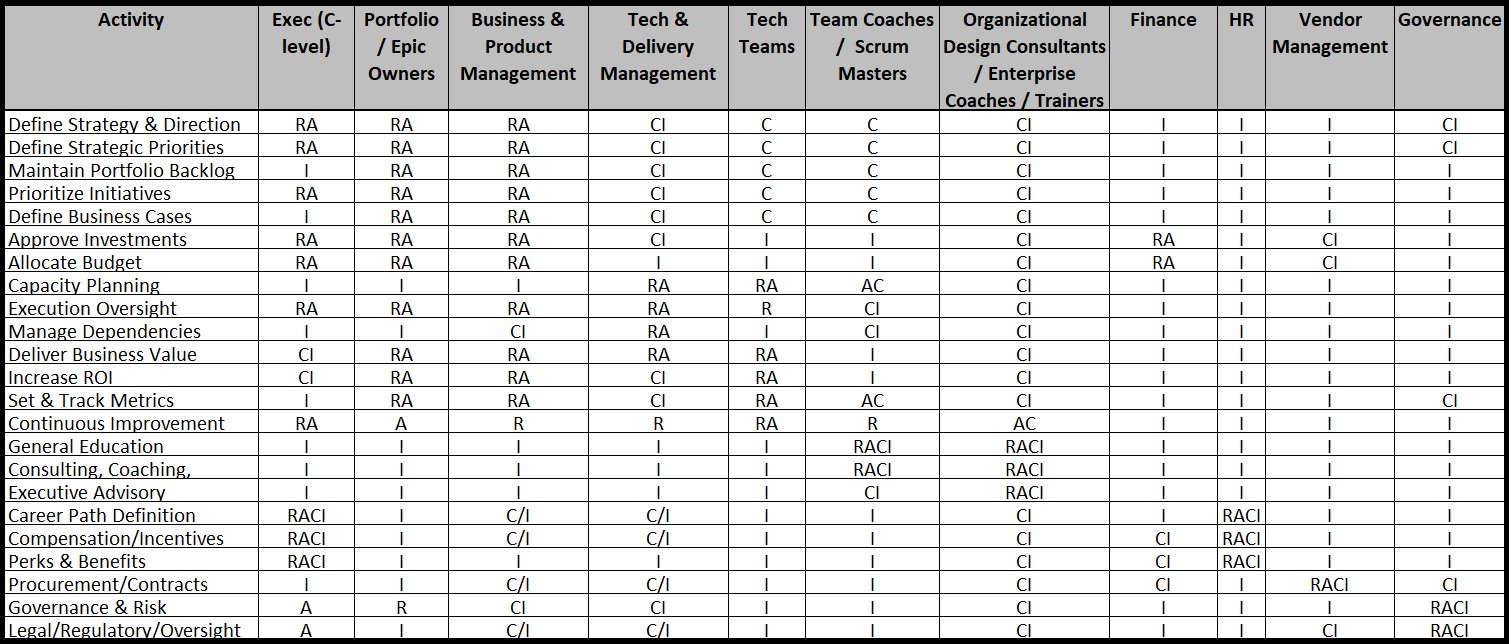
Frameworks like Scrum, Large-Scale Scrum (LeSS), and Lean Portfolio Management (LPM) embody this shift. Instead of decomposing work across many specialized roles, they bring accountability closer to the teams that deliver value. Roles are intentionally limited, but each carries a wider scope of responsibility. As a result, RACI—if it exists at all—becomes simpler and more fluid. It is not unusual to see combined designations such as RA, AC, or CI, reflecting shared ownership and collaboration rather than strict separation.
This simplification has profound effects. It reduces handoffs, minimizes dependency chains, and weakens the conditions that enable blame. When multiple roles share responsibility and accountability, success and failure are no longer isolated to individuals—they are collective. Conversations shift from “Who owns this?” to “How do we solve this together?” Organizational silos begin to dissolve, replaced by cross-functional alignment and mutual accountability.
In this light, RACI does not disappear—it evolves. It becomes a lightweight guide rather than a rigid contract. It supports clarity without enforcing artificial boundaries. And most importantly, it aligns with a broader organizational philosophy: one that values adaptability over control, collaboration over hierarchy, and outcomes over ownership.
A modern, lean RACI example reflects this mindset. Instead of distributing single letters across many narrowly defined roles, it clusters responsibility within a smaller set of broader roles, often combining accountability and execution. The result is not only simpler to understand, but also more aligned with how work actually gets done in adaptive systems.
In the end, the lesson circles back to the quiet insight from Who Moved My Cheese?: the fear of losing one’s place often leads to behaviors that limit growth. In organizations, that fear manifests in structures designed to protect roles rather than enable progress. Letting go of that rigidity—whether in mindset or in tools like RACI—creates space for something more resilient, more collaborative, and ultimately more effective.
As an organization, you should ask yourself a question: in which direction do we wish to go?
See, an example of RACI matrix below.